We earn a commission if you buy through our links, at no extra cost to you.
Best Riding Lawn Mower for Hills and Steep Slopes
How to measure your slope, why the operator's manual sets the limit, and which riding mowers publish a slope figure. Includes the degrees-versus-percent math.
At a glance
Choose by the slope limit in the operator's manual, not by brand. Among our picks, the EGO Power+ Z6 ZT4205S e-STEER and the EGO Power+ Z6 ZT5207L state 15-degree slopes under ideal conditions. If your hill is steeper than your mower's limit, use a trimmer or hire a landscaper.
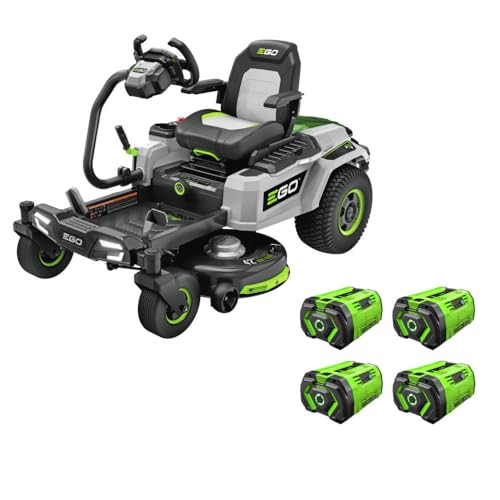
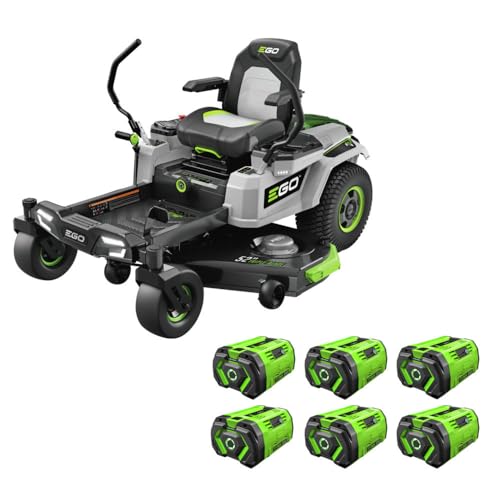
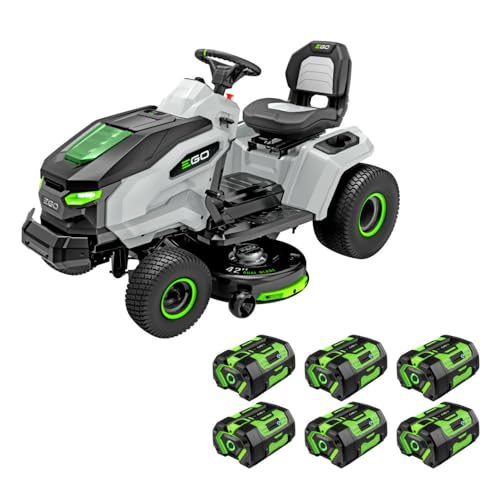
Hills change which riding mower you should buy. On flat ground you compare deck width, battery range or engine size. On a slope, the first question is whether the machine should be there at all. This guide explains how to measure your slope, how to read what a manufacturer does and does not publish, and which models on our site state a slope figure. It does not promise that any mower is safe on a hill, because no mower is, and no one can promise that without seeing your yard, your grass and your operator’s manual.
We compared published specifications and public safety guidance. We did not drive these machines on slopes, and nothing here replaces the manual that ships with the mower.
Why Slopes Are the Hazard to Respect
The Consumer Product Safety Commission puts it plainly in its rotary power mower safety tips: “Slopes are a major hazard for riding mowers.” It adds that riding mower operators have been injured or killed when a mower overturns, or when a driver or extra rider falls off. The same page says children have been severely injured when an operator goes into reverse without looking behind first. Never carry passengers, and never let a child ride or operate a mower.
OSHA’s riding mower page, written for workplaces but sensible for homeowners, gives three instructions worth remembering:
- Do not operate a mower on slopes that exceed the angle limits specified by the manufacturer, and check the mower for a label with that information.
- Avoid mowing slopes of more than 15 degrees if no other information is available.
- Do not mow side to side on sloped ground. Always mow slopes in the up-and-down direction.
The first rule is the one that matters most. The manufacturer’s limit comes first. The 15-degree fallback applies only when you have nothing else, and OSHA states that its 15 and 22 degree figures are based on instructions provided by manufacturers.
How to Measure Your Slope
Slopes feel steeper than they are, so measure instead of guessing. You have three common ways to describe the same hill: rise over run, percent grade and degrees.
Rise over run. Lay a long, straight board on the slope, level it with a carpenter’s level, and measure the vertical gap under the downhill end. The gap is the rise. The board’s horizontal length is the run. A stake-and-string line pulled level between two points works the same way on longer banks.
Percent grade. Divide rise by run and multiply by 100. Ten feet of rise over 100 feet of run is a 10 percent grade.
Degrees. Degrees are the inverse tangent of rise divided by run. The same 10 percent grade is about 5.7 degrees. The math is not linear, which is why the numbers surprise people:
| Rise over 100 ft of run | Percent grade | Approximate angle |
|---|---|---|
| 10 ft | 10 percent | 5.7 degrees |
| 20 ft | 20 percent | 11.3 degrees |
| 27 ft | 27 percent | 15 degrees |
| 40 ft | 40 percent | 21.8 degrees |
Note that 15 degrees is not “15 percent.” It is a grade of roughly 27 percent, which is a noticeably steep lawn. A manual that says 15 degrees and a hill that measures 15 percent are very different things, so confirm which unit you are reading. A smartphone inclinometer app, or a digital level set against a straight board, will read degrees directly. Measure several spots, because the steepest strip of the yard sets your limit, not the average.
Reading the Manufacturer’s Slope Limit
Where a limit is published, it is usually conditional. EGO’s pages for the ZT4205S and ZT5207L both say that under ideal conditions the machine can handle 15-degree slopes. The ZT4205S page adds that surface moisture, sidehilling, tire pressure, drive mode and speed all affect traction and slope performance. Treat “ideal conditions” as dry, short grass, firm ground and the correct tire pressure. Wet grass, loose soil and clippings take you outside that promise.
Many pages publish nothing. The EGO T6 TR4204 page and the Craftsman T110 page state no slope limit, and our profiles of the Craftsman Z5400, T2200K and T2400 found none either. A missing number on a product page does not mean the machine is fine on any hill. It means you read the operator’s manual and the label on the mower, and if you cannot find a limit, you treat the slope as off limits or call the maker.
Zero-Turn or Lawn Tractor on a Slope
The honest answer, based on the sources we read, is that the layout does not replace the limit. A zero-turn mower steers by changing the speed of its drive wheels, which is why abrupt moves matter on any incline. A lawn tractor steers with a wheel and has the familiar feel of a car. Neither the CPSC nor OSHA ranks one design as safer on hills, so we will not either. What the sources do say is consistent: stay under the maker’s angle, mow up and down rather than across, avoid wet grass, and go slowly.
The EGO ZT4205S e-STEER adds a steering wheel to a zero-turn. EGO says the wheel controls only the rear wheels. That changes the steering feel, not the published 15-degree condition.
Models on Our Site That Publish a Slope Figure
Only two of the eight machines we cover state a slope figure on the maker’s page. Both are battery zero-turns from EGO, both are premium-range, and both carry a “Coming Soon” label on EGO’s pages as we write this, so confirm availability and what is included in the kit on the Amazon listing.
EGO Power+ Z6 ZT4205S e-STEER: Published 15 Degrees, Smaller Deck
A 42-inch battery zero-turn with a steering wheel and a stated 15-degree slope under ideal conditions, for open yards with some gentle grade.
According to EGO, this model has a 42-inch deck, four 12.0Ah batteries, a 320 lb weight and a claim of up to 2.5 acres per charge. It publishes more of the numbers a hill buyer needs than most other pages we compared: a slope figure, a weight and a list of factors that reduce traction. The trade-offs are its premium tier and the fact that “ideal conditions” is a narrow window. Read the full EGO ZT4205S profile.
EGO Power+ Z6 ZT5207L: Published 15 Degrees, Wider Deck
A 52-inch lap-bar battery zero-turn that states the same 15-degree slope under ideal conditions, for larger properties with moderate grade.
EGO lists a 52-inch fabricated steel deck, six 12.0Ah batteries and up to 4 acres per charge. EGO’s page lists no weight for this model, so if weight matters for your terrain or trailer, check the manual. It is overkill for a small lot. See the EGO ZT5207L profile.
A Gentle-Grade Option With No Published Limit
EGO Power+ T6 TR4204: Tractor Layout, Read the Manual
A 42-inch battery lawn tractor for mostly open lawns with gentle grade; EGO's page states no slope limit, so the manual decides.
The TR4204 is a tractor-style machine with a 42-inch deck, six 6.0Ah batteries, up to 1.5 acres per charge and a top speed of 6 mph, according to EGO. We include it because many owners want a familiar tractor layout and no engine upkeep. We do not recommend it for a hill, because EGO’s page gives no slope figure and we will not borrow the Z6 number. It suits mostly flat lawns with a slight grade, provided the manual’s slope instructions allow your terrain. See the EGO T6 TR4204 profile.
The Craftsman Models: Read Before You Buy
Craftsman’s T110 page lists no slope limit, and our profiles found none on the Z5400, T2200K or T2400 pages either. The Craftsman Z5400 profile and the Craftsman T110 profile each say so, and each ends the same way: follow the slope instructions in the manual and do not guess. If your yard has real grade, download the operator’s manual for the exact model before you order, find the slope section, and compare it with your measurements. If the manual allows less than your steepest section, choose a different tool for that section.
Habits That Matter More Than the Model
These are general practices drawn from the CPSC and OSHA pages above and from common sense. None replaces your manual.
- Mow slopes only when the grass is dry. EGO lists surface moisture as a traction factor.
- Mow up and down, not across, as OSHA advises.
- Go slowly and avoid sudden steering or speed changes. EGO lists speed and drive mode as slope factors.
- Look behind you before reversing.
- Never carry passengers and keep children and pets out of the mowing area.
- If your mower was designed with a roll-over protective structure, keep it upright and in place, and use the seat belt as the manual directs. OSHA notes that such a structure has limits.
- Stop and re-measure if a section feels steeper than you thought.
When the Slope Is Too Steep for Any Riding Mower
If your measurement exceeds the limit in the manual, or you cannot find a limit, the riding mower is the wrong tool for that part of the lawn. Your options are a string trimmer, a walk-behind mower rated for the terrain, or a landscaper who has the equipment and training. Another option is to stop mowing the bank: ground cover, mulch beds or native planting can replace turf on the steepest strip. No product on this page changes that, and we will never tell you a machine is safe on a hill.
Bottom Line
Measure first, in degrees, at the steepest point. Then match it to a published limit. On our site, the EGO Z6 ZT4205S and ZT5207L state 15 degrees under ideal conditions, and the other models we cover state nothing, which means the manual rules. For the full field, see our ranking of the best riding lawn mowers of 2026, or the profiles for the Craftsman T2200K and others linked above.
Sources
- CPSC: Safety tips for rotary power mowers
- OSHA: Dangers of roll-overs of riding mowers
- EGO POWER+ 42” Z6 Zero Turn Mower with e-STEER (ZT4205S), official product page
- EGO POWER+ 52” Z6 Zero Turn Riding Mower (ZT5207L), official product page
- EGO POWER+ 42” T6 Lawn Tractor Kit (TR4204), official product page
- Craftsman 42 in. 17.5 HP gear drive gas riding mower T110, official product page
Frequently asked questions
What slope can a riding lawn mower handle?
Only the angle printed in your operator's manual or on the machine's label. EGO states that its ZT4205S and ZT5207L can handle 15-degree slopes under ideal conditions. The Craftsman T110 page and the EGO T6 TR4204 page state no slope limit, so for those the manual is the only authority.
How do I convert a slope from percent to degrees?
Divide the rise by the run to get the grade, then take the inverse tangent for degrees. A 10-foot rise over a 100-foot run is a 10 percent grade, about 5.7 degrees. A 15-degree slope is a grade of roughly 27 percent, or about 27 feet of rise over 100 feet of run.
Is a zero-turn or a lawn tractor better on a hill?
Neither layout is a guarantee. A zero-turn steers by changing the speed of its drive wheels, and a tractor steers with a wheel, but the maker's slope limit applies to each. We found no source that ranks one layout as safer, so we do not claim it.
Should I mow across a slope or up and down?
OSHA's riding mower guidance says not to mow from side to side on sloped ground and to always mow slopes in the up-and-down direction. Check the manual for your machine, because it may add its own instructions.
What if my slope is steeper than the mower's limit?
Do not mow it with the riding mower. Use a string trimmer, a walk-behind mower suited to slopes, or hire a landscaper. Converting a bank to ground cover or mulch beds is another way to remove the mowing job.
Does a roll-over protective structure make hills safe?
No. OSHA notes that a protective structure is not unlimited in its ability to protect the operator, and that it must be in place and upright to work as intended on mowers designed for one. Many residential models do not have one, so check yours.